Backyard Wedding Guide: Real Costs, Permits and Logistics
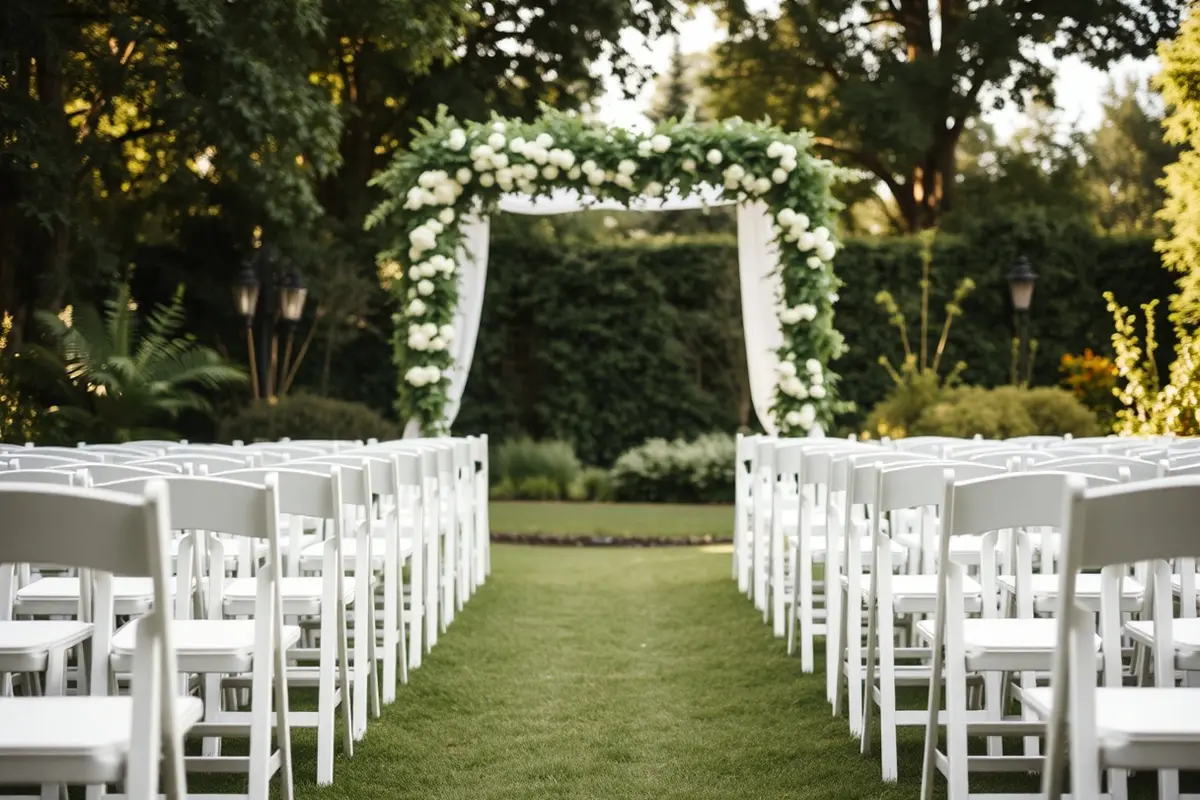
A backyard wedding for 100 guests typically costs $10,000–$20,000 in site build-out alone in 2026 - tent, tables, restrooms, power, lighting, and catering infrastructure - before you've paid for food, photography, or flowers. The yard is free; the venue you construct on top of it is not. Couples who plan around that reality save real money, and couples who don't often spend more than they would have at a mid-range rented venue.
The "home means cheap" assumption is the single most expensive mistake in backyard wedding planning. This guide breaks down what you're actually renting, the restroom and generator math, the permits and noise ordinances nobody mentions until a neighbor calls the county, and the honest cases where a backyard beats a traditional venue - and where it doesn't.
Is a backyard wedding actually cheaper than a venue?
Usually not by as much as couples expect, and sometimes not at all. Skipping a venue saves the $6,000–$12,000 rental fee a comparable wedding venue would charge - then hands most of it back as line items, because a venue fee quietly bundles a building, restrooms, a commercial kitchen, parking, insurance, staff, and code compliance. At home, every one of those becomes a rental with its own delivery fee.
Where the "free venue" money goes:
- A tent, because 100 guests won't fit in the living room: $1,500–$4,500 installed for a standard frame tent, $3,500–$7,000+ for sailcloth.
- Restrooms, because two house bathrooms on a residential septic system cannot absorb 100 guests over six hours: $1,200–$3,500 for a trailer.
- Power, because a caterer, band, lighting, and restroom trailer out-draw a house panel: $350–$900 in generators.
- Everything a venue's storage room holds - tables, chairs, linens, place settings, a dance floor, trash service, lot lighting: $3,500–$8,000 for 100 guests.
Where backyard weddings genuinely win is control: no venue minimums, no in-house vendor lists, no 10-hour rental window, no next-morning cleanup deadline, and the option to shrink the guest list without paying for empty ballroom capacity. Run your numbers through a budget calculator with the rental column filled in honestly before deciding the house is the cheap option.
How much does a backyard wedding cost in 2026?
For the site alone - the physical build that turns a lawn into a functioning event space - expect roughly $6,000–$12,000 for 50 guests, $10,000–$20,000 for 100, and $14,000–$26,000 for 150 in 2026. Add your normal catering, photography, attire, and flowers on top, and a 100-guest backyard wedding lands in the same $25,000–$40,000 territory as the mid-market US average.
Site build cost by guest count
| Guest count | Tent + tables + chairs + settings | Restrooms + power + lighting | Total site build (before food, photos, flowers) |
|---|---|---|---|
| 50 | $3,500–$6,500 | $2,500–$5,500 | $6,000–$12,000 |
| 100 | $6,500–$12,500 | $3,500–$7,500 | $10,000–$20,000 |
| 150 | $9,500–$16,500 | $4,500–$9,500 | $14,000–$26,000 |
Two pricing patterns worth knowing:
- Costs scale with guests almost linearly at home. A venue's fee is mostly flat whether 80 or 140 people show up; your tent, chair, and restroom counts are not. A micro wedding of 30–50 guests in a real backyard is one of the few setups where "home" and "cheap" genuinely coexist.
- Delivery fees stack. Six vendors each charging $150–$400 for delivery to a residential address adds $1,000–$2,000 that never appears in any single quote. Consolidating with one full-service rental company typically costs slightly more per item and meaningfully less in total.
What does the house actually need brought in?
Assume the property provides grass, a view, and sentimental value - and price everything else. Cross off only what the house genuinely covers, and be honest about the septic system and the breaker panel.
| Need | Why the house can't cover it | Rental cost, 100 guests |
|---|---|---|
| Tent, sidewalls, rain plan | No indoor room seats 100 | $1,500–$4,500 |
| Tables, chairs, linens | Ceremony and reception seating | $1,800–$4,000 |
| Place settings, glassware | Home kitchens hold service for 12 | $600–$1,500 |
| Restrooms | 2 bathrooms + septic vs. 100 guests | $1,200–$3,500 (trailer) |
| Power | House circuits run 15–20 amps each | $350–$900 (generator) |
| Catering prep space | Residential range, no health-code prep area | $400–$1,200 (prep tent) |
| String/area lighting | Yard goes black at 8:30 p.m. | $600–$2,000 |
| Dance floor | Heels + lawn = ankle injuries | $400–$900 |
| Trash + haul-away | Curbside cans hold two bags | $250–$600 (dumpster) |
| Parking plan | Driveway fits 4 cars | $300–$1,500 (shuttle or lot) |
| Lawn prep and repair | Mowing, leveling, post-event reseeding | $500–$2,500 |
Totaled, the bring-in column runs roughly $8,000–$23,000 for 100 guests. Many couples hire wedding planners specifically for backyard builds - a from-scratch site is closer to producing a small festival than booking a venue, and a coordinator's $1,500–$4,000 fee routinely pays for itself in avoided rental mistakes and a wedding day where someone other than your father is directing the tent crew.
Restrooms, power, and parking: the math nobody does
Restrooms
The planning standard is one restroom stall per 50–60 guests for a 5–6 hour event - so 100 guests need at least two stalls, realistically a two-station restroom trailer at $1,200–$3,500 for the weekend. Trailers need a 20-amp circuit, level ground, and a garden hose connection; confirm all three on a site visit before booking.
Do not route guests through the house as the primary plan. Most residential septic systems are sized for a family of four or five - 100 guests flushing for six hours is how septic failures happen mid-reception, and emergency pumping on a Saturday night runs $500–$1,200. If you're on city sewer, limit house access to the wedding party and rent units for everyone else.
Power
A typical house circuit carries 15–20 amps. A caterer's warming equipment alone can draw 30–50; add a band or DJ rig, string lighting, and a restroom trailer and the event wants 60–100 amps your panel can't spare. The fix is the same as any off-site event:
- Collect load sheets from your caterer, your DJ or band, the lighting installer, and the restroom-trailer company.
- Add 25% headroom to the total.
- Rent a quiet inverter or towable generator sized to that number - a 25 kW unit runs $350–$700/day plus fuel and covers most 100–150 guest weddings.
- Place it 75–100 feet from the tent, downwind, behind a fence line; run cable ramps over every walkway.
- Dedicate one small 7–10 kW unit ($150/day) to the caterer so the first dance can't kill the ovens.
An electrician can sometimes run a temporary spider box off the house's 240V service instead ($300–$800) - worth pricing, but no daisy-chained extension cords.
Parking
A residential street absorbs 40–50 cars badly and 100-guest weddings generate 40–60 of them. Options that work: a rented lot at a nearby church or school ($100–$500 for the day) with a shuttle ($500–$1,500), a valet crew stacking a long driveway, or a hard "rideshare only" line on the invitation. Whatever you pick, tell the neighbors in writing two weeks out - blocked driveways generate the complaint calls that bring police attention to your noise situation at 9 p.m.
Do you need permits for a backyard wedding?
Often yes, and the couples who get surprised are the ones who assumed private property meant no rules. Requirements vary by city and county, but four categories come up constantly:
- Tent permits. Many jurisdictions require a permit and sometimes a fire inspection for tents over 400 sq ft - which is essentially every wedding tent. Reputable tent companies pull the permit for you ($50–$300); confirm whose job it is in the contract.
- Noise and amplified-sound rules. Most residential zones enforce quiet hours starting 9–10 p.m., and some cities require a special-event or amplified-sound permit ($25–$300) for any outdoor music. This is the rule that ends receptions early. Get your local cutoff in writing and build the timeline backward from it - or plan an indoor or acoustic final hour.
- HOA and short-term-rental rules. If the property has an HOA, read the covenants before you send invitations - event restrictions, parking limits, and guest caps are common. If the house belongs to someone else, confirm in writing that events are allowed.
- Health and alcohol. Caterers generally carry their own permits but some counties require notice for large private events with hired food service. Private property does not exempt you from liquor liability: use a licensed, insured bartender ($40–$75/hour) rather than an open self-serve table.
Then there's insurance. A homeowner's policy was not written for a 100-guest event with alcohol and vendors, and a single injury claim can exceed its liability cap. Expect to buy a one-day special-event policy - $1,000,000 per occurrence typically costs $150–$400 in 2026, plus roughly $75–$150 for host-liquor coverage - and require certificates of insurance from every vendor working the property. The full breakdown is in our wedding insurance guide, but the short version: this is the cheapest line item on the whole budget and the worst one to skip.
When a backyard wedding beats a venue - and when it doesn't
Backyard weddings win when:
- The guest list is under 75. Rental costs scale per head at home; small lists keep the build cheap enough to genuinely undercut venues.
- The property is the point. A family home, a parent's garden, land with real meaning - no venue buys that, and it shows in the photos.
- You want total control. Your vendors, your timeline, your bar, no corkage fees, no forced end time except the county's.
- You have a long runway. Backyard builds reward 10–12 months of planning; the lawn work alone starts a season ahead.
A venue wins when:
- The guest list is 120+. At that size the tent-restroom-power stack usually costs more than a venue fee, with triple the coordination load.
- Nobody on the property wants a construction project. The house's owners host a multi-day load-in, absorb the lawn damage, and wake up to a dumpster. That's a real ask of your parents.
- Weather is genuinely hostile. August in the Gulf South or a shoulder-season mountain evening means climate-controlling a tent - and at that point the logistics converge with a raw-barn build, with similar costs.
- You want to enjoy the week before your wedding. A venue compresses setup into hours; a backyard spreads it across days, and someone you love is managing it.
If you're weighing this against other outdoor formats, our outdoor wedding planning guide covers the weather-contingency side in depth.
Step-by-step: planning a backyard wedding
- 10–12 months out: measure the yard, check it against your guest count (plan roughly 20 sq ft per guest for tented dinner seating plus dance floor), and call the city or county about tent, sound, and event permits before committing.
- 9–10 months: book the tent and core rentals, the caterer, and a coordinator. Ask every vendor directly: "Have you worked residential sites?" - the answer sorts them fast.
- 8 months: buy the event liability policy; notify the HOA if there is one; start lawn work if the ceremony area needs regrading or new sod.
- 5–6 months: site walk with the caterer, DJ or band, tent company, and coordinator together - map power, water, load-in paths, restroom-trailer placement, and the generator location on one shared document.
- 2–3 months: finalize the parking and shuttle plan; hand-deliver a friendly note to every neighbor within earshot with the date, the music cutoff, and your phone number.
- 2 weeks: confirm delivery windows - tent Thursday, everything else Friday, nothing Saturday morning. Recheck the forecast and trigger the sidewall/heater/fan add-ons if needed.
- Day before: walk the finished site at dusk: restrooms powered and stocked, generator fueled and test-run, lighting on, cable ramps down, sprinkler system off - the classic 2 a.m. sprinkler cycle has soaked more than one reception layout.
Frequently asked questions
How much does a backyard wedding cost for 50 guests?
Typically $6,000–$12,000 for the site build - tent, seating, restrooms, power, and lighting - plus normal catering and vendor costs. Under about 75 guests is where backyard weddings genuinely beat venue pricing, because every rental scales per head.
Do I need a permit to get married in my own backyard?
The marriage itself needs no venue permit, but the event often does: tent permits above 400 sq ft, amplified-sound or special-event permits for outdoor music, and HOA approval where covenants apply. Call your city or county clerk 10+ months out - rules are hyper-local and the fixes are cheap early and painful late.
Can guests just use the bathrooms in the house?
Not as the primary plan for more than about 30 guests. Residential plumbing - especially septic - isn't sized for event traffic, and a mid-reception backup is a real and recurring failure mode. Budget $1,200–$3,500 for a restroom trailer at one stall per 50–60 guests and let the house handle overflow only.
What's the biggest hidden cost of a backyard wedding?
The stack of small ones: delivery fees across six vendors, lawn prep and repair, trash haul-away, a parking solution, and the day-after teardown labor. Individually they're $250–$2,500 each; together they add $2,500–$6,500 that no single quote ever shows you. Price the whole stack before comparing against a venue's flat fee.
Ready to find your venues?
Browse verified venues on Weddli, with real reviews and transparent profiles.
Browse Venues