How to Choose a Wedding Officiant: Types, Costs and Fit
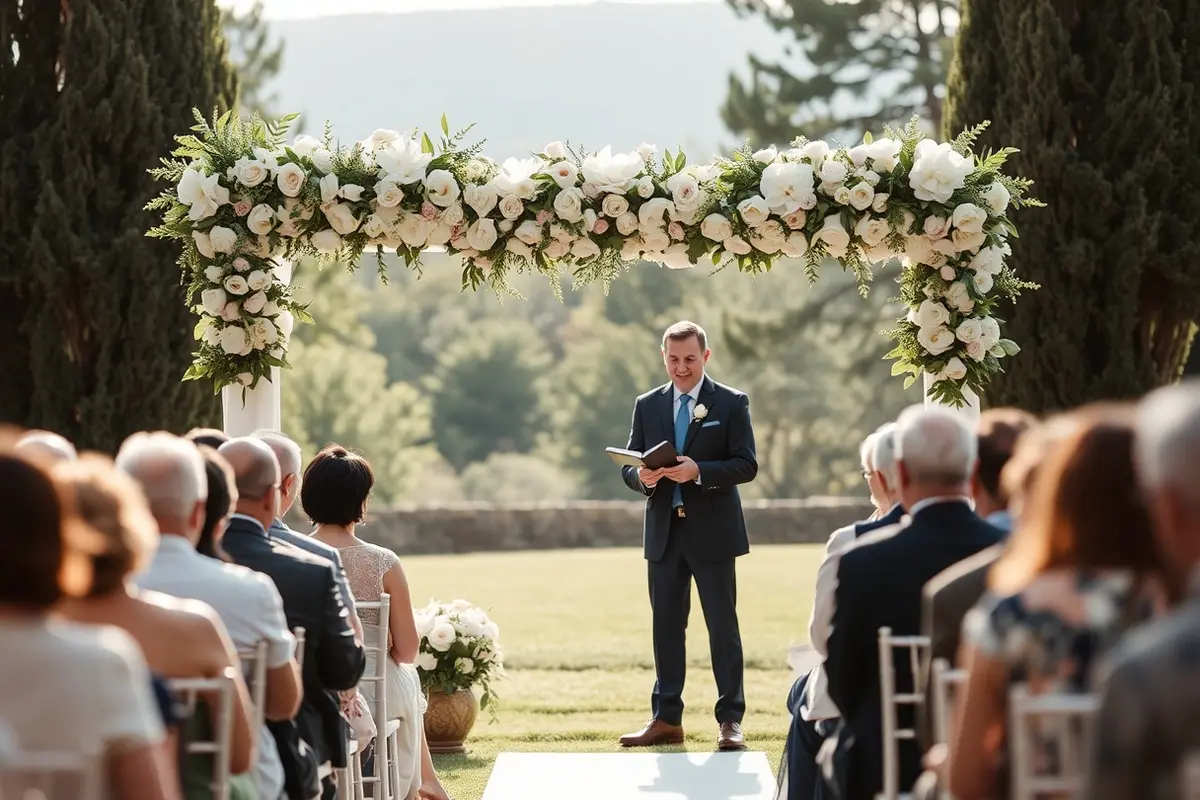
Choosing a wedding officiant comes down to four options: religious clergy (typically a $200–$800 honorarium in 2026), a civil officiant ($25–$150 at a courthouse), a professional officiant or certified celebrant ($300–$800, up to $1,200+ in major metros), or a friend who gets ordained online for roughly $0–$50. The price gap is the least important difference - what you're actually choosing is who writes the 25 minutes everyone watches, whether your marriage is legally valid in your state, and who's responsible when the license needs filing on Monday.
The officiant is the cheapest line on a $30,000–$35,000 wedding budget and the one with the most screen time - guests won't remember the napkin fold, but they'll remember the ceremony that ran 50 minutes in the sun. This guide breaks down the four types, what each costs, the ceremony-style conversation you need to have before booking, and the rehearsal and paperwork logistics nobody mentions until they go wrong.
What are the four types of wedding officiant?
Every legal US wedding officiant falls into one of four buckets, and each comes with a different default ceremony, cost, and amount of control over the script.
- Religious clergy - a priest, pastor, rabbi, imam, or other faith leader. The ceremony follows the tradition's liturgy, often with limited room for customization. Some clergy only marry congregation members, and some traditions require premarital counseling (typically 4–8 sessions).
- Civil officiant - a judge, justice of the peace, court clerk, or county-appointed marriage commissioner. Short, legally airtight, script-standardized; the courthouse version runs 5–10 minutes.
- Professional officiant or certified celebrant - someone who marries couples for a living. Celebrants train formally in ceremony writing; both build a custom script from interviews, handle the license correctly, and perform dozens of weddings a year.
- Friend or family member - ordained online, usually free or under $50. Total control of the tone, zero professional experience, and the legal and performance risk lands on you.
Type comparison at a glance
| Officiant type | Typical 2026 cost | Ceremony style | Customization | Best for |
|---|---|---|---|---|
| Religious clergy | $200–$800 honorarium (+ possible facility fees) | Traditional liturgy, 30–60 min | Low–moderate | Couples active in a faith community |
| Civil (judge/JP) | $25–$150 (+ travel if off-site) | Standard legal script, 5–15 min | Minimal | Elopements, legal-first couples, tight budgets |
| Professional / celebrant | $300–$800; $800–$1,200+ in major metros | Fully custom, 20–30 min | High | Most venue weddings, interfaith or secular couples |
| Friend or family | $0–$50 ordination + gift | Whatever you write together | Total | Couples who value the personal connection over polish |
If you're going the professional route, start browsing wedding officiants 8–10 months out - good ones book one wedding a day and Saturdays go fast.
How much does a wedding officiant cost in 2026?
Expect to spend $300–$800 for a professional officiant in most US markets in 2026, with experienced celebrants in the Northeast, coastal California, and destination markets running $800–$1,200+. Against a mid-market wedding budget, that's typically 1–2% of total spend - the best cost-to-impact ratio of any vendor category.
What that fee usually includes, and what it doesn't:
- Included at the $300–$500 tier: one planning call, a semi-custom script built from a questionnaire, ceremony performance, and license signing. Rehearsal attendance is usually an add-on at $75–$150.
- Included at the $600–$1,200 tier: two to three planning meetings, a fully custom ceremony written from interviews, unlimited revisions, rehearsal attendance, a backup-officiant guarantee, and license filing handled for you.
- Travel fees: expect $0.50–$1.00 per mile beyond a 30–50 mile radius, or a flat $50–$200 for out-of-area venues.
- Clergy honorariums: typically $200–$800, framed as a donation rather than a fee. Ceremonies in the house of worship itself add facility fees - often $500–$2,000 for members, more for non-members - plus possible organist or cantor fees.
- Civil ceremonies: courthouse fees run $25–$150 depending on the county, plus the marriage license itself ($20–$115 in most states). A judge traveling to a private venue, where allowed, typically charges $200–$400.
- Friend officiant: online ordination is free to $50. Budget a thank-you gift ($100–$200) and, honestly, a backup plan - more below.
One line couples forget: gratuity. Clergy honorariums usually are the tip; for professionals, an extra $50–$100 for an excellent job is common - see the vendor tipping guide for how this fits alongside your other vendors.
Religious, civil, celebrant, or friend: which fit is right?
The right answer hangs on three questions: how much control do you want over the script, does the ceremony need to satisfy a family or faith requirement, and how much legal and performance risk can you tolerate?
When religious clergy is the right call
If you're active in a congregation, this is often the easiest and most meaningful path - the officiant already knows you, and the ceremony carries weight a stranger can't replicate. The trade-offs are real: many traditions restrict venue (sanctuary only), require premarital counseling with 2–4 months of lead time, limit personal vows, and won't perform interfaith ceremonies. Ask about all four in the first conversation, not after you've booked a barn.
When a civil officiant wins
Civil is the right answer when the legal marriage is the point: elopements, courthouse-plus-party weddings, couples doing a private legal ceremony before a symbolic one abroad. It's also the honest budget play - $25–$150 all-in versus $300+ - and pairs naturally with a micro wedding under 30 guests. The trade-off is a fixed script and, at the courthouse, a weekday time slot with a two-guest witness limit in some counties.
When to hire a professional or celebrant
This is the default for most venue weddings, and for good reason: you get a custom ceremony without asking anyone for a favor. Professionals solve the problems you don't know exist yet - they project without shouting, angle you both toward the photographer during the kiss, keep the ceremony to the 20–30 minutes guests actually enjoy, and know your state's license rules cold. Interfaith and secular couples especially benefit - a good celebrant can weave two traditions into one ceremony.
When a friend makes sense
A friend officiating can genuinely be the best moment of the day - when the friend is a confident public speaker, takes the prep seriously, and you accept that they can't fully be a guest. They'll spend cocktail hour being congratulated instead of relaxing, and they own a legal task with a deadline. If your candidate is beloved but not a performer, a common compromise: hire a professional for the legal ceremony and have the friend deliver a reading or the welcome.
Should a friend officiate your wedding? The honest logistics
Yes, if you handle four things that the "get ordained online, it's easy!" version skips.
- Verify legality in your specific state and county. Most states accept online ordination, but a handful of states and individual county clerks have challenged or restricted it, and some route friend-officiants through a different mechanism entirely - a one-day designation or a self-uniting license. Have your friend call the county clerk issuing the license and confirm in writing what documentation they need - before you print programs.
- Give them a real deadline structure. Ordination: 6 months out. First full script draft: 8 weeks out. Final script: 3 weeks out, printed in a binder - phones die and glare in sun. A full read-through out loud at least twice; a ceremony script reads 30% faster in your head than it performs.
- Assign the license explicitly. After the ceremony, the signed license must be returned to the county - typically within 10 days, in some states within 3–5. This is the classic friend-officiant failure: the license rides home in a glove compartment and the couple discovers months later they're not legally married. Put "mail license" on someone's wedding checklist with a name and a date.
- Line up a backup. If your friend gets the flu, a professional on standby (some offer standby bookings for $100–$200) or a pre-identified ordained guest saves the day.
The ceremony-style conversation: what to ask before you book
Book the officiant on fit, not on price - a $200 gap is invisible in your budget and enormous in your ceremony. Before signing, ask for evidence:
- "Can I see full video of a recent ceremony?" Not a highlight reel - you're evaluating pacing, warmth, volume, and whether they read the script or perform it. Highest-signal ask on this list.
- "How does the ceremony get written?" The good answer involves interviewing you both - separately, ideally - and building the story from your answers. The weak answer is a template with your names swapped in.
- "How do you handle religious content?" Whether you want none, a little, or a full liturgy, make sure their default matches your intent - "spiritual but not religious" means different things to different officiants.
- "What's your policy on personal vows?" If you're writing your own vows, a good officiant coaches length (aim for under 2 minutes each), holds printed backup copies, and structures the ceremony so the vows land as the peak.
- "How long is your typical ceremony?" The guest-comfort sweet spot is 20–30 minutes. Under 15 feels rushed at a formal wedding; over 40 loses the crowd, especially outdoors.
- "How many weddings do you take per day and per weekend?" One per day is the answer you want. Officiants stacking three Saturday ceremonies are the ones who arrive at 4:58 for a 5:00 start.
- "What happens if you're sick?" Professionals should name their backup network. No backup plan is a red flag at any price.
- Sound: confirm who provides the microphone. An unmiked officiant in front of 100+ guests outdoors is inaudible past row four - coordinate a lavalier or handheld with your ceremony musicians or DJ, and if you're filming, tell the officiant they'll wear a second audio recorder - vows are the part of the film you'll actually rewatch.
Does the officiant run the rehearsal?
Sometimes - and you need to know who does before the week of. Professional officiants at the $600+ tier usually include rehearsal attendance; at the $300–$500 tier it's a $75–$150 add-on that's worth it. Clergy almost always run rehearsals for ceremonies in their own house of worship. Civil officiants don't attend rehearsals at all.
If the officiant isn't coming, someone still has to run it - typically your coordinator or wedding planner, working from the officiant's script outline. The rehearsal is really about mechanics, not words:
- Processional order and pacing (30–45 minutes covers a standard rehearsal)
- Where everyone stands - including the detail everyone forgets: the officiant stepping aside for the kiss so they're not in every photo
- Who holds the rings, when vow cards change hands, and where bouquets go
- Cue coordination with the musicians for the processional and recessional
Day-of, a professional arrives 30–45 minutes before the ceremony, checks the mic, confirms the license is on site, and briefs the wedding party on any changes. Build that arrival into your day-of timeline explicitly; "the officiant knows when to show up" is an assumption, not a plan.
When should you book your wedding officiant?
Book 8–10 months out for a professional officiant or celebrant, 10–12 months for in-demand clergy (counseling requirements add lead time), and 6+ months before asking a friend. Courthouse ceremonies can usually be scheduled 2–8 weeks ahead.
Officiant booking sits in the 8-to-10-month window of a 12-month planning timeline, after the venue and date are locked:
- 10–12 months: if clergy, start now - confirm counseling requirements, venue restrictions, and availability.
- 8–10 months: interview 2–3 professional officiants; watch full ceremony videos; book on fit. Deposits typically run $100–$200.
- 6 months: friend-officiant track - ordination done, county clerk requirements confirmed in writing.
- 2–3 months: ceremony draft delivered and reviewed. Decide on vows, readings, and any unity ritual now, not the week of.
- 3–6 weeks: get the marriage license. Most are valid 30–90 days and several states impose a 24–72 hour waiting period - the officiant should know the exact window for your state.
- 1 week: final script confirmed, rehearsal time confirmed, mic plan confirmed with the sound vendor, license in a named person's hands.
Frequently asked questions
Can anyone officiate a wedding in the US?
In most states, yes - clergy (including online-ordained friends), judges, and certain public officials can solemnize marriages, and a few states allow couples to self-solemnize with no officiant at all. Rules are enforced by county clerks, so confirm with the clerk issuing your license rather than relying on the ordination website.
How much should we budget for an officiant?
Plan on $300–$800 for a professional in 2026, $200–$800 as a clergy honorarium, or under $150 for a civil ceremony - roughly 1–2% of a typical US wedding budget. Run it against your other lines in a budget calculator; no vendor gets more uninterrupted guest attention per dollar.
How long should the ceremony be?
Aim for 20–30 minutes for a standard wedding, 15–20 for outdoor ceremonies in heat or cold, and 5–10 for an elopement. Full religious liturgies run 45–75 minutes; if that's your tradition, plan guest comfort around it.
What if the officiant cancels last minute?
Ask about backup coverage before booking - established professionals maintain a substitute network, and celebrant associations often cover each other. For friend officiants, identify a backup yourself: a standby professional booking ($100–$200) or an ordained guest who has read the script. The party can survive most failures; an unsigned license can't.
Ready to find your officiants & ceremony?
Browse verified officiants & ceremony on Weddli, with real reviews and transparent profiles.
Browse Officiants & Ceremony